
Wednesday, 2 October 2013

Tuesday, 1 October 2013
Narratives using theorys
The villain: Ronald, the princess’s evil half-brother
The donor: Jim, gives the hero a sword in his time of need for the battle
The helper: Herbert, helps Andrew defeat Ronald in the battle
The princess: Rosetta, is in danger when her half-brother returns
The dispatcher: Anita, informs Andrew that Ronald has returned to the Kingdom, he must save them all
The hero: Andrew, saves
the Kingdom and restores peace
Roland Barthes-
Roland Barthes-
Enigma/Hermeneutic codes: We find out during the climax of the
narrative that Ronald is evil.
Therefore throughout the story mystery and suspense is built.
Action codes:
When Ronald pulls out his sword, the audience know that a battle is about to
take place.
Multi strand narrative: It is not a multi strand narrative as there is only one plot
built up in a single episode.
Linear pattern: The story follows a chronological order, beginning, climax and
end (resolution).
Tzvetan Todorov-
Equilibrium:
The narrative begins with an existing state of harmony where Rosetta is looking
forward to her birthday and her half-brother visiting her.
Disequilibrium: Rosetta finds out why her brother left the kingdom, he was evil
and tried to kill her father in order to gain status and become the King. A
dual takes place between Ronald and Andrew the brave knight, when the Kingdom
find that he has returned.
New Equilibrium: Ronald is defeated and never again returns to the Kingdom to
cause harm, the Kingdom live in harmony and peace is restored.
Monday, 30 September 2013
parallel and contrapuntal sound- Indiana Jones
What went well ?
- Brilliant choice of music.
- contrapuntal images were consistent until the sixth image .
- parallel images very movie driven , fits the cinematic feel , adventure genre.
Even better if?
- proof reading.
- image of brides maid stood out and pictures are no longer consistent
- did images need titles as audience should be able to establish what's contrapuntal and what's parallel.
- I have used a continuous theme throughout the video and should have kept it the same I changed the images as I felt that I should allow my audience to understand that there is a range of images that could have had a contrapuntal effect and not just horror. In the future if I were to re-do this task I would make images consistent and also remove the titles at the bottom of the screen so the audience have a chance to establish what is what.
Wednesday, 25 September 2013
Analysing TV episodes using theory's
Analysing- the Simpsons season 6 episode 1

Roland Barthes-
Enigma/Hermeneutic codes: Bart see’s ned burying something and we hear screaming however we
don’t see what was buried which keep the audience in the dark about what has
happened or happened.
Action codes:
Multi strand narrative series: the episode does contain multi strand narratives as there
are many problems such as it’s very hot and they had a pool temporarily and
then after wanted to get one for the back garden.
Linear or Non-linear pattern: linear the episode follows an A-B style
narrative as it is in chronological order. Saying what happens in steps of
taking place e.g. it was very hot, so they got a pool, Bart tried to show off
and broke his leg, this is a basic example to show linear narratives.
Tavian Tomorrow-
Equilibrium:
Disequilibrium:
New Equilibrium: Bart confront Ned about what had happened and asks about what he berried in the garden which lead to Ned admitting what he had done and everybody is that happy and balance is when restored again.
Vladimir Prop - The seven spheres of action
The villain:
The donor:
The helper:
The princess:
The dispatcher:
The hero:
the hero is Bart although Lisa was the dispatcher Bart had to try to save Lisa but
found the truth out when he helped her
Film noir

Research on film noir
Film noir consists of dark, moody and dramatic
cinematography, the genre of film noir instantly conjures cinematic scenes in your mind of New York detectives.Film noir is from
the French word "noir" translates to "black" or
"dark," and film noir describes a style of film making rather than an
actual film genre. At the heart of film noir is a dramatic story, often filled
with crime and sexual scenarios. The lighting is sometimes either stark
dark or light contrasts as are the dramatic shadowing effects known also as the
chiaroscuro style; Chiaroscuro is a style of light and dark. One typical cliché
and always notable scene type is the shadows of characters. an example
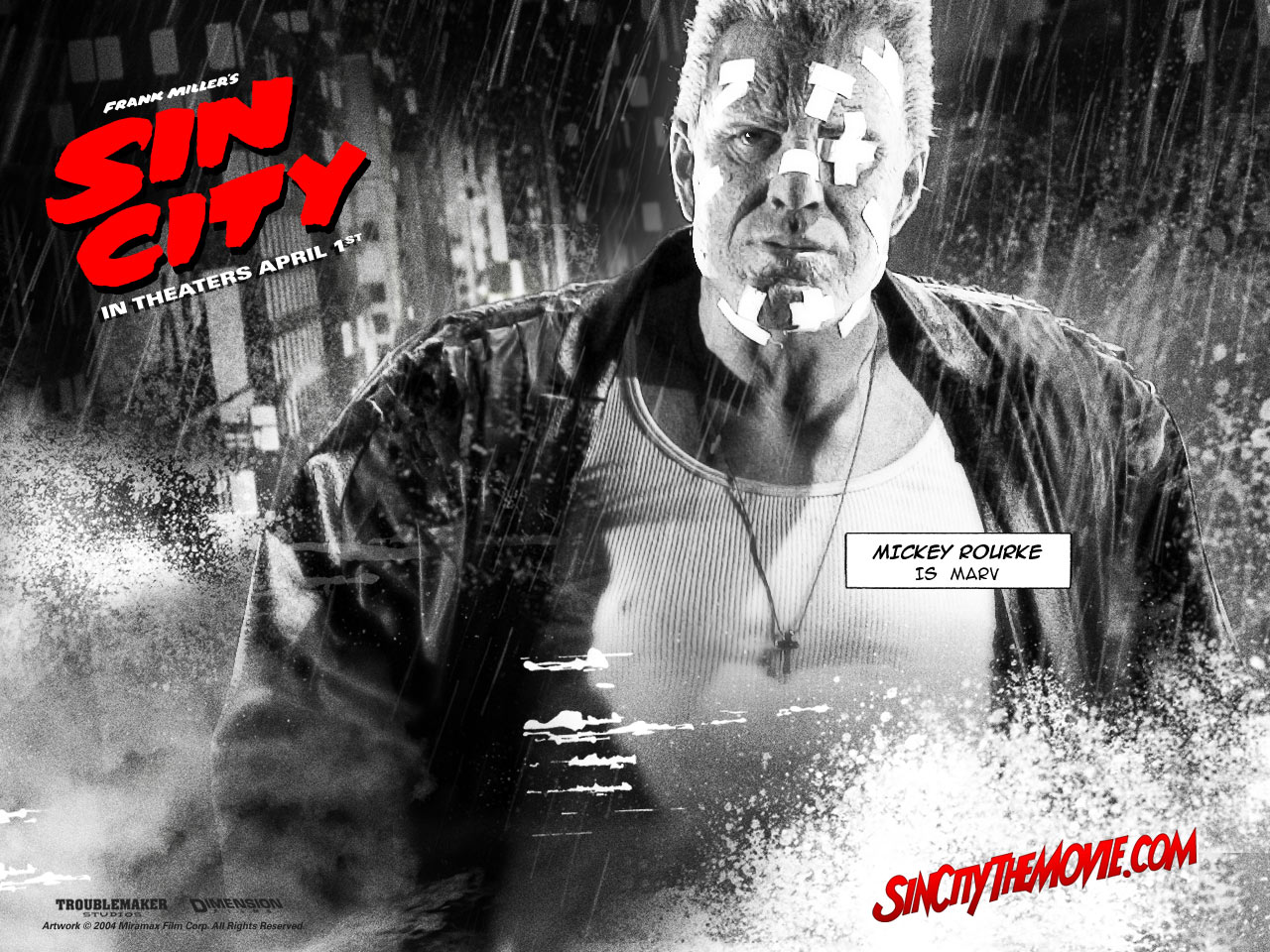
The poster of sin city is a very good example of film noir it uses a contrast of dark and light to show the genre of the film, the dark shadows used help the audience assume that there is danger and mystery however the white and lighter areas suggests that there is hope. the film poster has powers boothe as the in the central showing him as the main focus also his face consists of many plasters which suggests violence due to the use of plasters also it allows the audience to then assume that it is a typical genre of film noir which is crime. the light helps to give clues of many aspects such as where the film is set in the back a filler top light may have been used to show the setting as light on the apartment is added in order to show a suggestion of where it the film is set, also the tiles of the film "Sin City" helps us to understand that the film could perhaps also be set on in the city.
The trailer of the film uses lots of light and dark scenes in order to continue with the film noir, at 15.5 second of the trailer the scene is dark and is then lit up by the sirens and headlight of police cars tho allows the audience to identify the genre which is crime. Throughout the trailer many scenes of the characters are shown as still images showing a black and light grey outline of the character face along side the name which continues the theme of film noir but also tell the audience who and what the film will be about. at 48 seconds a scene of a man with long hair is used the left hand side of his face is lit up and the right hand side is left with a more natural form of light which could be either created by the moon or recreated using stage lighting , also the left hand side of the face gets lighter due to the thunder and lighting used which makes the audience feel that there is danger but also some form of evil in the film as lighting can connote danger, pain and evil. The trailer uses a range of shots in order to portray different views and ideas of the character to the audience.
Monday, 23 September 2013
Stuart Hall
Stuart Hall

Stuart hall(1980) he discovered the theory of encoding and decoding , his theory is different from althusser in emphasizing more scope for diversity of response to media text.Halls argued that the dominant ideology is typically inscribed as the preferred reading in a media text. however this is not easily adopted by all readers ,some readers only take in what they see and not break down the image to understand any other meanings but the one shown by the news paper. dominant reading is what the creator intends for the audience to believe, the negotiable reading is an alternative reading that is completely opposite tot he writers intentions. Oppositional reading are a middle ground not being biased one side but understand both the dominant reading and negotiable reading and are 50/50.

Subscribe to:
Posts (Atom)